Prompt version control: comparing approaches
Four approaches to prompt versioning compared: Git-native, dedicated platforms, hybrid sync, and feature flags. Platform landscape data and deployment workflow tradeoffs examined.

TL;DR: Four main approaches exist for prompt version control: Git-native, dedicated platforms, hybrid sync, and feature flags. The right choice depends almost entirely on who needs to edit prompts and how fast changes need to reach production - not on which approach has the best feature list.
As LLM-powered applications move into production, teams face a recurring operational question: how should prompts be versioned, tested, and deployed? The answer is not universal. It depends on team structure, deployment cadence, and who actually needs access to change prompts. This piece compares four approaches in active use today, with data from platform documentation, developer surveys, and practitioner reports from 2025-2026.
Why prompt versioning matters
A prompt in production is more than a text template. It includes model configuration (temperature, model ID, max tokens), system instructions, few-shot examples, and often conditional logic. When any of these changes, the system's behavior changes. Without version tracking, debugging production issues becomes guesswork.
A 2025 Braintrust analysis found that prompt versioning has evolved from an optional development practice to essential infrastructure for production AI systems. The key driver is reproducibility: when a user reports unexpected behavior, teams need to know exactly which prompt version was active at that time.
Four approaches compared
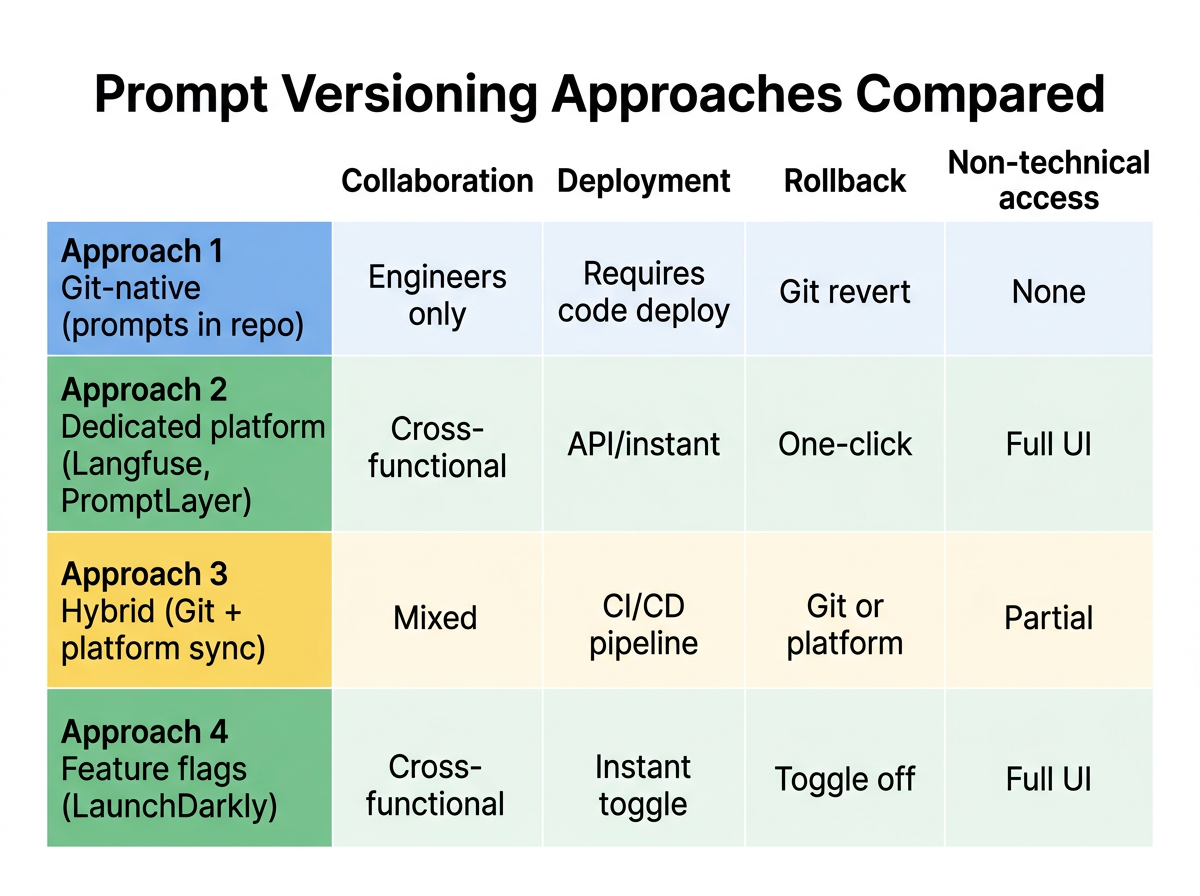
Git-native versioning
The simplest approach: prompts live in a Git repository alongside application code. Every prompt change goes through pull requests, code review, and CI/CD - the same process as any code change.
Teams report the biggest advantage is familiarity. No new tools, no new infrastructure, and prompts get the same review process as code. A 2025 Dev.to analysis noted that Git-native versioning provides natural audit trails and integrates with existing workflows.
The friction shows up in iteration speed. Deploying a one-word prompt change through a full CI/CD pipeline is slow, and non-engineers cannot contribute without pulling in a developer. For teams doing rapid prompt experimentation, the review-deploy-test cycle becomes a bottleneck that discourages iteration.
Dedicated prompt management platforms
Platforms like Langfuse, PromptLayer, Maxim AI, and others provide purpose-built interfaces for versioning, testing, and deploying prompts independently of application code.
Prompt changes deploy instantly via API, without a code release. Non-technical team members - product managers, domain experts, content specialists - can iterate through a visual interface. Most platforms include built-in evaluation, A/B testing, and rollback. Nearform's comparison of prompt management systems found dedicated platforms significantly reduce time between prompt iteration and production deployment.
The risk is dependency. Prompts fetched at runtime create a network dependency: if the platform goes down, prompt delivery can fail (most platforms offer client-side caching as mitigation). There is also vendor lock-in risk - Humanloop's acquisition and subsequent shutdown in 2024 demonstrated this concretely. Teams that had relied on it needed emergency migrations.
Hybrid approach
Some teams keep prompts in Git as the source of truth but sync them to a platform for runtime delivery. CI/CD pipelines push changes from Git to the platform on merge.
In theory, this combines the review rigor of Git with the runtime flexibility of a platform. In practice, teams report the sync pipeline requires careful engineering to avoid drift between Git and platform state. It also does not fully solve the non-technical contributor problem, since prompt changes still need to go through Git before reaching the platform.
Feature flag-based versioning
An approach gaining traction: treat prompt versions as feature flags. Different users or segments receive different prompt versions based on targeting rules. LaunchDarkly's prompt versioning guide describes this pattern in detail.
For teams already using feature flags for code, this is the path of least resistance - prompt versioning comes free within existing tooling. Granular rollouts (5% of users get the new prompt version) and instant rollback by toggling a flag are genuine advantages.
The reported friction: feature flag systems were designed for boolean toggles, not complex multi-paragraph prompt templates with variables and conditionals. Teams report managing prompt content in a flag interface is awkward at scale, and flag proliferation (every prompt variant becomes a flag) can make the flag inventory unmanageable without discipline.
The deployment workflow matters more than the storage choice
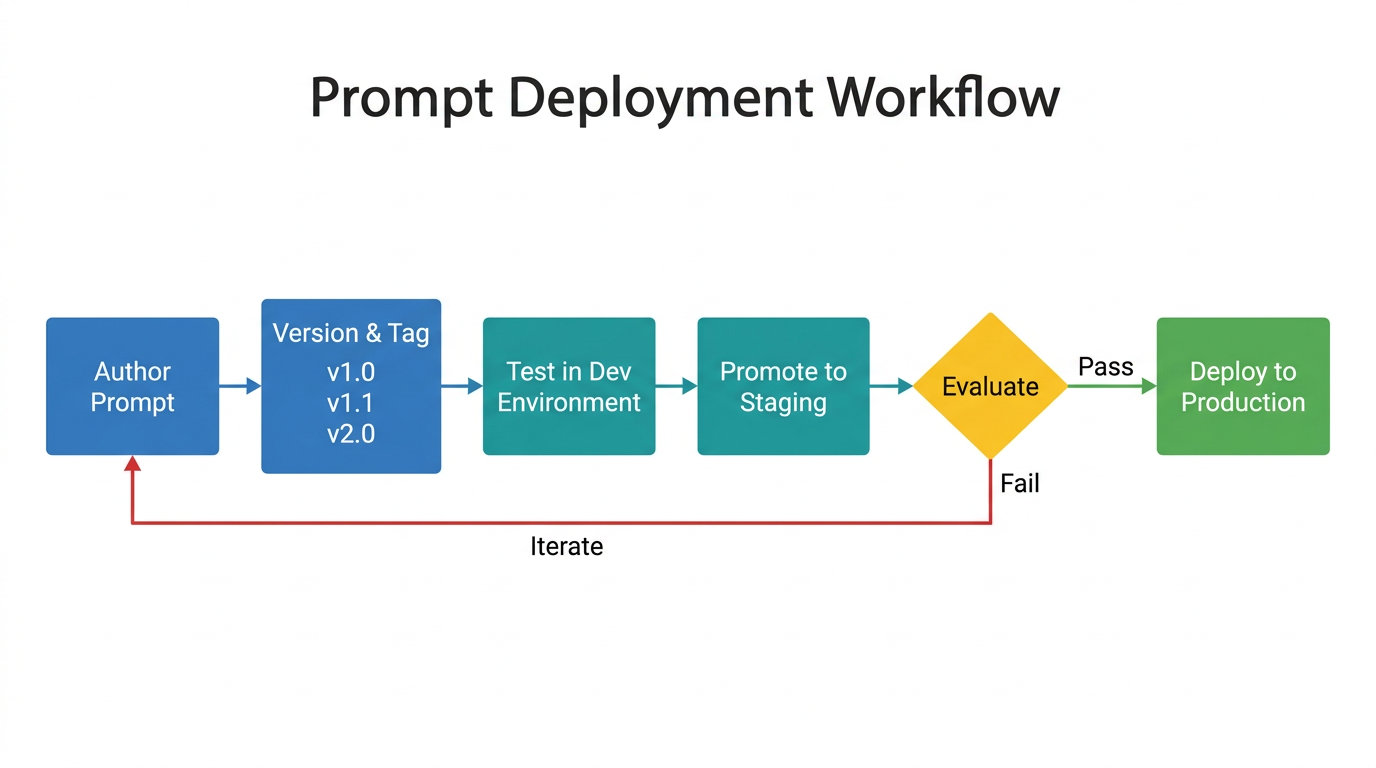
Looking across teams that report low prompt-related incident rates, a pattern emerges: the deployment workflow they use - how prompts move from authoring to production - appears to matter more than which storage approach they chose. The most common stages: author and version the prompt, test in a dev environment, promote to staging, evaluate against known test cases, then deploy or iterate.
This workflow is independent of the underlying approach. Git-native teams can implement it through CI/CD. Platform teams implement it through environment promotion. The key variable is whether the team has evaluation steps baked into the flow at all.
The platform landscape in 2026
For teams considering a dedicated platform, the 2026 platform landscape has several notable characteristics. Langfuse and Agenta offer self-hosted, open-source options (MIT licensed), which has made them popular among teams that prioritize control after the Humanloop shutdown. PromptLayer and Maxim AI are cloud-only but offer more polished collaboration features. Braintrust supports a hybrid Git-plus-platform model. The features have converged - most platforms now offer versioning, environment management, and basic evaluation. The differentiators in 2026 are around self-hosting flexibility, non-technical UI quality, and ecosystem integration.
What the data suggests
Teams where only engineers edit prompts and changes are infrequent often find Git-native versioning sufficient - the overhead of a dedicated platform may not be justified. Teams with cross-functional prompt editing tend to benefit from dedicated platforms or feature flag systems. Teams wanting code review rigor with faster deployment may prefer the hybrid approach, accepting the complexity of maintaining sync between Git and a runtime platform. Teams already heavily invested in feature flags may find flag-based versioning a natural extension, provided they verify their flag system handles complex prompt templates well.
The evidence suggests that the teams reporting the fewest prompt-related production incidents are those that matched their versioning approach to their organizational structure and invested in evaluation workflows regardless of which specific approach they chose.
Related links
Stay in the loop
Get notified when we publish new posts. No spam, unsubscribe anytime.