GPT-4o retirement and the forced prompt migration: what production teams face
OpenAI retires GPT-4o March 31. The Assistants API follows in August. What actually breaks during forced model migrations, what the deprecation timeline looks like, and how production teams are managing it.

TL;DR: OpenAI is retiring GPT-4o from the API on March 31, 2026, with the Assistants API following on August 26. The replacement model, GPT-5.1, handles system messages differently, enforces stricter JSON schema adherence, and uses a new API primitive (Responses) that replaces the Threads/Runs architecture entirely. Teams that pinned to GPT-4o and never tested forward are facing the hardest migrations. Here is what actually breaks, what the timeline looks like, and how teams are managing it.
On February 13, 2026, OpenAI pulled GPT-4o from ChatGPT. Four days later, the chatgpt-4o-latest snapshot disappeared from the API. On March 9, Azure began auto-upgrading standard deployments to GPT-5.1. And on March 31, the GPT-4o API endpoints go dark permanently.
If your production system still points at GPT-4o, you have weeks. Not months.
This is not the first forced model migration, but it is the broadest. GPT-4o, GPT-4.1, GPT-4.1 mini, and o4-mini are all retiring in the same window. The Assistants API, which entire product architectures were built on, shuts down on August 26. And the replacement infrastructure, the Responses API, is not a drop-in swap. It is a different paradigm.
The deprecation cascade
The timeline matters because the dates are staggered across platforms, creating confusion about exactly when things break.
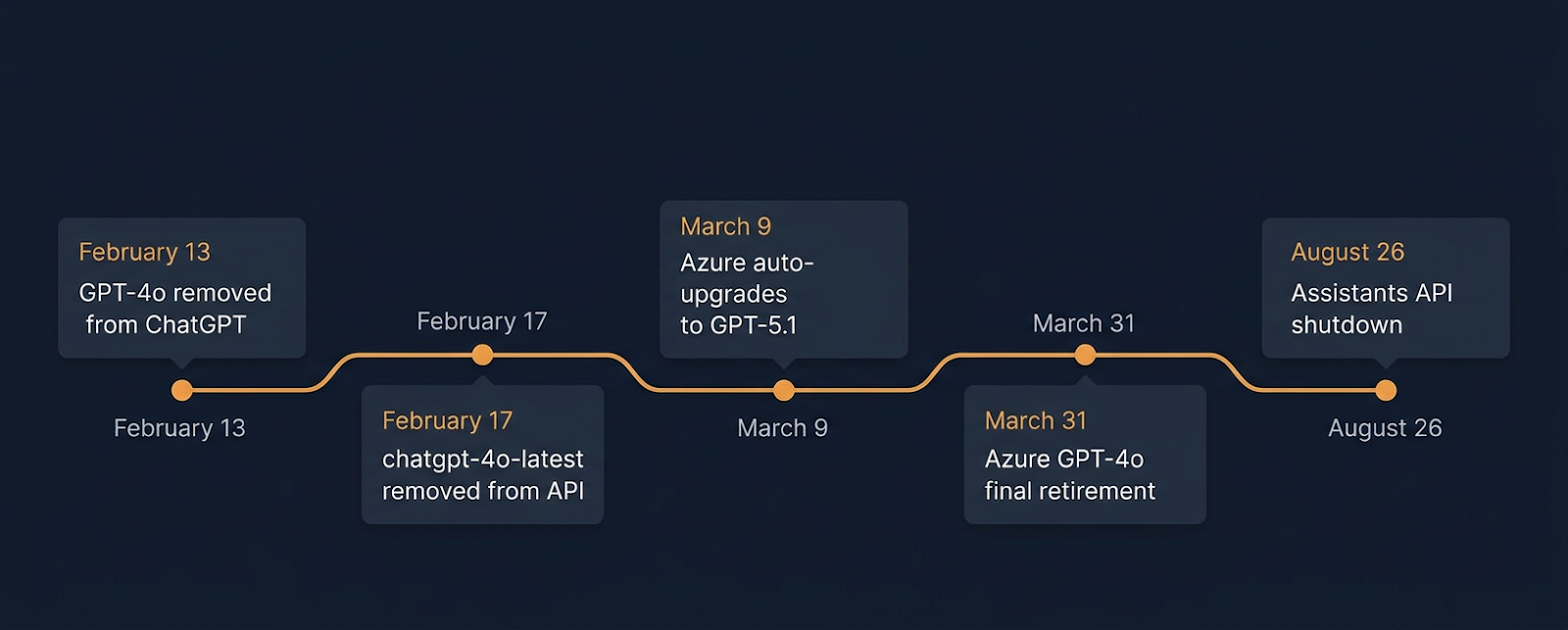
February 13: GPT-4o, GPT-4.1, GPT-4.1 mini, and o4-mini removed from ChatGPT. The default model becomes GPT-5.2. Business and Enterprise customers retain GPT-4o in Custom GPTs until April 3.
February 17: The chatgpt-4o-latest model snapshot is removed from the API. Any deployment using this model ID starts returning errors.
March 9: Azure OpenAI begins auto-upgrading standard deployments to GPT-5.1 (version 2025-11-13). If you opted into auto-upgrade, your model changes without a code deploy on your side.
March 31: Final retirement of GPT-4o (versions 2024-05-13 and 2024-08-06) on Azure. After this date, API calls to these model versions return 404 errors. Fine-tuned GPT-4o deployments get a one-year grace period.
August 26: Assistants API endpoints stop functioning entirely. All Threads, Runs, and Vector Store integrations built on the Assistants API cease to work.
OpenAI reported that only about 0.1% of users still selected GPT-4o daily before the ChatGPT retirement. But API usage is a different story. Production systems do not casually switch models the way individual users do.
What actually breaks
The migration from GPT-4o to GPT-5.1 is not a model swap. It is a behavioral change with at least three distinct failure modes.
Structured output parsing. GPT-5.1 has stricter adherence to JSON schemas. If your old prompts relied on GPT-4o "figuring out" a loose schema, GPT-5.1 may reject it as malformed. Conversely, GPT-5.1 sometimes produces valid but differently structured JSON, breaking parsers that expect a specific field order or nesting pattern.
System message handling. GPT-5 follows an instruction hierarchy: system messages override developer messages, which override user messages. Prompts that relied on implicit conventions or loose instruction boundaries may behave differently. GPT-5.1 requires more explicit instructions. Implicit constraints that GPT-4o inferred from context may no longer work.
Verbosity calibration. GPT-5.x models are less verbose by default. Prompts that included instructions like "Be concise" may overshoot, producing responses that are too brief. The opposite problem: prompts without length guidance may get shorter responses than expected, breaking UX assumptions about response length.
The pattern across all three: prompts tightly coupled to GPT-4o's specific behavioral quirks break more often than prompts written as clear, explicit instructions. This is consistent with what we documented in the model updates and prompt stability analysis earlier this year.
The Assistants API migration surface
The Assistants API deprecation is a bigger architectural change than the model swap. OpenAI is replacing the entire Threads/Runs paradigm with the Responses API, which uses a fundamentally different mental model.
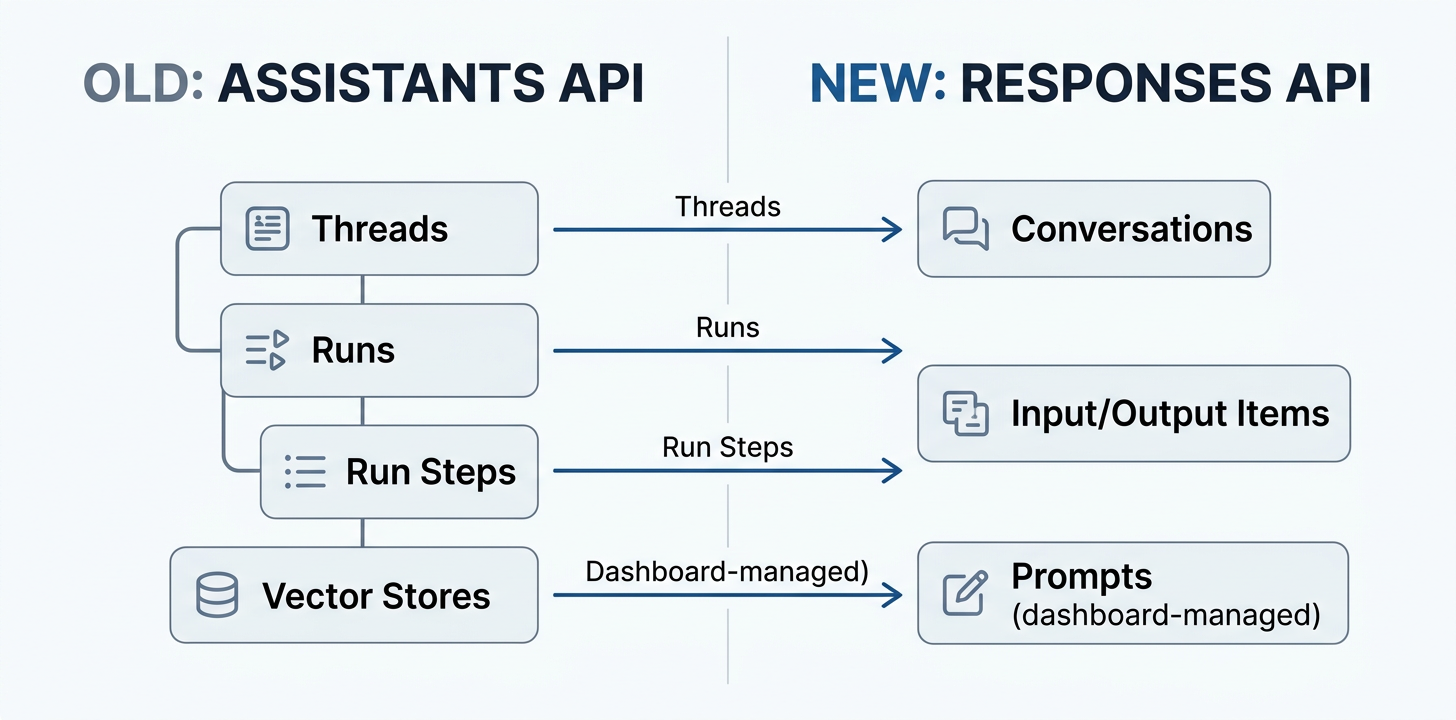
The mapping is not one-to-one. Assistants become Prompts (dashboard-managed and versionable). Threads become Conversations (stream-based item architecture). Runs become Responses (explicit tool orchestration). Run Steps become Items (unified message/tool/output handling).
There are three state management approaches in the new architecture, and they are mutually exclusive in some combinations. You cannot use previous_response_id while using a Conversation. Teams need to choose their architecture, not just swap API calls.
The migration guide identifies high-impact applications as those with multi-turn assistants relying on thread/run polling, file-heavy RAG using vector stores with citations, or complex tool workflows depending on run-step lifecycles. For these applications, the seven-month migration window from January to August 2026 is tight, especially considering the need for shadow traffic comparison phases.
Cost structures also shift. File search storage runs $0.10/GB/day after 1GB free. File search calls cost $2.50 per 1,000. Web search calls cost approximately $10 per 1,000 plus content tokens.
What the migration data shows
A structured migration framework study from the Tursio enterprise search application found that systematic prompt migration, with regression testing at each step, reduced migration effort from several months to a couple of weeks. The key factor was treating prompts as versioned artifacts with explicit test suites rather than as static strings embedded in application code.
The pattern emerging from production postmortems is consistent. Teams that had three things in place before the deprecation announcement fared best: version-controlled prompts with rollback capability, automated regression test suites covering critical paths, and model-agnostic prompt architecture (prompts not coupled to model-specific quirks).
Teams without these reported the highest migration costs: not in API fees, but in engineering time. Integration work, evaluation infrastructure, prompt maintenance, reliability fixes, and cross-provider observability all contribute to what industry analysts are calling LLM total cost of ownership, where token spend is often the smallest line item.
Managing the migration
The practical playbook for teams facing the March 31 deadline is straightforward, even if the execution is not.
Audit first. Inventory every API call that references a GPT-4o model ID. Include Azure deployments, fine-tuned models, and any hardcoded model strings in configuration files.
Test before you swap. Run your existing prompts against GPT-5.1 in a staging environment. Prompt management platforms like EchoStash support deployment targets (dev, staging, prod) that let you test a new model version against your existing prompt library without touching production. Compare outputs semantically, not just as string matches.
Fix the prompts, not the model. If a prompt breaks on GPT-5.1, the fix is usually making implicit instructions explicit. Add specific formatting requirements. Specify output structure clearly. Remove workarounds for GPT-4o-specific quirks that GPT-5.1 does not need.
Plan for the Assistants API separately. The August deadline is further out but the migration is larger. Start the architectural assessment now. Map your current Threads/Runs usage to the Responses/Conversations model. Identify which state management pattern fits your application.
Build regression testing into the pipeline. The GPT-4o retirement will not be the last forced migration. Production postmortems consistently show that teams with automated regression testing (even 50 to 100 carefully chosen test cases) catch more regressions than those with thousands of synthetic examples. The investment pays forward across every future model transition.
What the data suggests
Forced model migrations expose a structural problem in how most teams manage prompts. When prompts live in application code, a model migration means a code migration. When prompts are managed as versioned, testable artifacts with model-agnostic rendering, a model migration means running a test suite.
The GPT-4o retirement is a forcing function. The teams that treat it as a one-time scramble will face the same pain at the next deprecation. The teams that use it as the reason to adopt proper prompt infrastructure, version control, regression testing, and deployment pipelines, will be better positioned for every model transition that follows.
The March 31 deadline is real. The August 26 Assistants API shutdown is real. The prompts are either versioned, tested, and ready, or they are not.
Related links
Stay in the loop
Get notified when we publish new posts. No spam, unsubscribe anytime.